Aaron Finch is struggling. It's the World Cup semi-final, and he's languishing on just 19 from 34 deliveries, batting well below his belligerent best. The ball is not hitting the middle of the bat, which feels like a toothpick in his hands. All he can do is dig in, and get down to the other end, to relative safety. But singles have been hard to come by...
The wily Mohit Sharma, one of India's best bowlers of the tournament, is bowling the 13th over. He delivers a well-pitched slower ball, the off-cutter. Finch defends, solidly, out into covers. He immediately calls "yes!", and takes off for the run. The athletic Indian fielders, sensing the nervousness of the Victorian, swoop like hungry raptors ready for the kill...
At the other end, Steven Smith could be forgiven for having a momentary lapse in concentration. After all, the 26-year old New South Welshman is playing in a World Cup semi-final at his home ground, the SCG; his second-last match of a cricketing summer that started way back in November 2014 (it is now the end of March 2015). In that time, he has lost one of his closest friends, Phillip Hughes, to a horrible accident, scored well in excess of 750 test match runs at an average of 128, while also captaining Australia in three tests. He's also aquired nearly 900 ODI runs in just 17 matches during this time. Not to mention winning the Allan Border Medal, Australian test cricketer of the year, and Australian ODI cricketer of the year along the way...
Instead, he is awake, as alert as ever, as mentally tough and together as they come. He bellows out "NO!", a commanding, piercing call. A call that oozes calmness and confidence, that no man would disobey. A call of a captain. Aaron Finch stops in his tracks, turns, and makes it back to the crease, as the Indian fielders rush in from all directions, hopeful for the run out. But it doesn't come. Finch and Smith go on to form a 182-run partnership. Australia win the match by 95 runs. Three days later, Australia win the World Cup.
And Steve Smith is there, in the final, to hit the winning runs. Michael Clarke, in his last ODI for Australia, had made a fluent 74, and put on 112 match World Cup winning-runs with Smith. But the time had come to pass the mantle on. Almost as if the script was written, Clarke chopped-on with just nine more needed. He hands the wheel to Steve Smith, his heir-apparent. Get comfortable, young man. This is what it feels like to sit on the throne. Enjoy it.
If any man deserves to hit the World Cup winning-runs, it's Steve Smith. From the darkest days of modern-Australian cricket back in 2013, to proving everyone wrong in the 18 months since, Steve Smith has, with his ungainly style and fidgety nature, inspired not only a nation of cricket followers to believe, but his own teammates as well. While Smith has been in the side, Australian cricket has gone from the depths and despair of the Homeworkgate incident in India, finishing last in their group in the ICC Champions Trophy 2013, and loosing the Ashes 0-3 in the same year, to the highs of winning against the highly fancied South Africans in their own backyard, and smashing England 5-0 in the corresponding Ashes series. He's seen it all, while all the while maintaining his supreme form in the middle order, often looking like he's been playing for Australia all his life.
So it seems only fitting that the changing of the guard took place in the middle of the MCG on Sunday night. The old gave way to new. As Michael Clarke left with a tear in his eye, Steve Smith looked every bit a leader as he flicked the ball off his hip for the winning runs. It could just have easily been Allan Border, Stephen Waugh or Ricky Ponting out there, calmly guiding Australia to yet another World Cup victory. Of course, Smith has dabbled in captaincy at the highest level, leading the Australian test team in three matches in the summer gone. He was successful, albeit conservative, not wanting to undo all the hard work of Michael Clarke before him. The calmness of his leadership was immediately evident, and it's only a matter of time until the flair and flamboyancy of his batting shines through in his captaincy.
As the changing of the guard takes place, as Australian cricket transitions into the next chapter, and with the world of cricket constantly evolving at a rapid rate of knots, Steve Smith will be there, in the thick of it all. And if Australia is to continue its assertive, winning ways, Smith will be the one leading the charge, flamboyant, inspiring, alert, and as mentally together as they come.
Tuesday, April 7, 2015

Friday, September 5, 2014
Southwest WA "Forrest Creek" Biotope
Those who know me know that I live and breath fish. I could spend hours just reading about them, or mucking around with my aquariums, or studying them in the wild and exploring their natural habitat. The latter is probably why I'm fascinated by the idea of biotope aquaria, and what gave me the idea to set up this little fish tank.
 |
| My take on a southwest Western Australia forrest creek biotope |
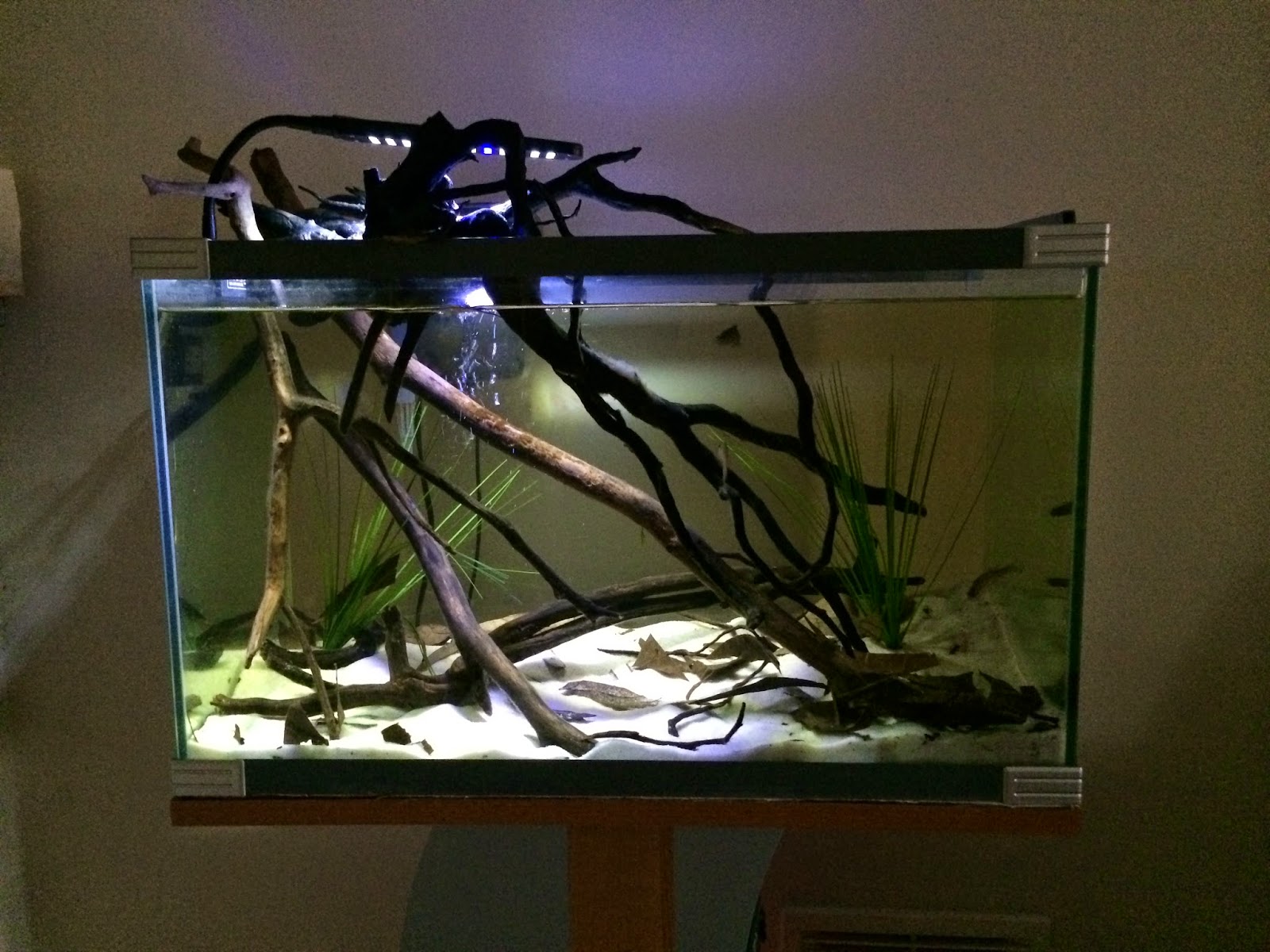
I really thought my 200 litre Amazonian aquarium would be enough to satisfy my fishy addiction. It turns out it wasn't. In fairness, this latest tank is basically a puddle at 60cm x 30cm x 30 cm (45 litres), so I figured it doesn't really count. Besides, this was going to be a highly educational project! My aim was to replicate a section of a forrest creek that I might find in my native southwest Western Australia, while stocking fish that are endemic to the region, and most importantly, of course, to do it on a budget!
 |
| The spectacular southwest, on which this biotope is based |
When choosing a fish tank, I would usually go for the biggest affordable (large tanks mean more consistent water quality, and lower maintenance). However, as I have previously learned, big tanks are harder to aquascape, much more expensive, and aren't always appropriate for biotopes such as this one. So, when I spotted a secondhand 45 litre tank (including stand) on Gumtree for just $100, I knew this was just the tank for me. For the type of fish I was planning to stock, anything larger seemed unnecessary, and I couldn't pass up such a bargain!
The hardscape
Many creeks in the southwest of WA are found trickling through areas of dense Jarrah and Marri forrest, and so the habitat I wanted to represent would feature a sandy bottom, lots of sunken woody debris, and leaf litter. I planned to have the water be slightly stained with tannins and lit dimly, with lots of dark, shady areas.
To start off, I collected some branchy driftwood from local creeks and wetlands. I was careful to soak and clean each piece thoroughly to get rid of any nasties (dirt, bacteria, parasites etc.), and I played around with the position of the wood until I was happy (a long and drawn out process for a perfectionist like myself!).
For the substrate, I used an undulating layer of Richgro playsand (washed thoroughly), on top of which sits a detritus layer of small twigs and Indian almond leaves (available from all good aquarium retailers). To add to the authenticity of the biotope, I cut the leaves into thin, crescent-shaped pieces, imitating eucalyptus leaves, which you will find littering the bed of pretty much any Australian creek (real eucalyptus leaves release oils and toxins, which can be leathal to fish).
For the substrate, I used an undulating layer of Richgro playsand (washed thoroughly), on top of which sits a detritus layer of small twigs and Indian almond leaves (available from all good aquarium retailers). To add to the authenticity of the biotope, I cut the leaves into thin, crescent-shaped pieces, imitating eucalyptus leaves, which you will find littering the bed of pretty much any Australian creek (real eucalyptus leaves release oils and toxins, which can be leathal to fish).
 |
| "Eucalyptus" leaves add authenticity to the biotope. |
Naturally, the growth of aquatic plants is limited in southwest forrest creeks, as little sunlight penetrates the tall canopy. Instead, emergent and riparian sedges and rushes, such as those from the Junkus genus, dominate. In the end, considering I wanted to the tank to be dim and shady, I decided against the use of native live plants, such as Vallisneria, Azolla and Potamogeton. Instead I opted for a couple of sedge-like silk 'plants', which I used to represent flooded riparian vegetation.
The hardware
Since this was a very simple setup, only the most basic of hardware was required to get the biotope up and running. For filtration, I decided to go with the Fluval Aquaclear 20, rated for around 76 litres/20 US gallons. Fortunately, the temperate climate of the southwest means the tank doesn't need a heater, which is a big money-saving bonus. I also didn't need bother with high tech lighting, in fact, for the dim effect I wanted for the tank, all I needed was a simple 3.5 watt LED strip (found on Ebay), which just clips on to the side of the glass. Too easy!
The fish
 |
| A wild pygmy perch displaying breeding colours |
Found in a range of habitats across the southwest, from sluggish swamps and wetlands to clear, flowing creeks, western pygmy perch reside in the shallows, usually amongst aquatic vegetation, feeding mainly on invertebrates from the creekbed.
Western pygmy perch are a perfect fit for aquarium life, being small (max. length: 8 cm), hardy and easily obtainable from local pond and aquarium retailers. They wont cost a small mortgage either at around $4 - 6 each. The perch exhibit an attractive mottled silver-grey colouration, while males display an enigmatic red-orange stripe on each flank when in breeding season. In the wild, pygmy perch can tolerate a temperature rage between 0 - 30 degrees C, and therefore don't require a heated aquarium. In fact, they make an ideal alternative for goldfish in a coldwater tank.
 |
| Playful pygmy perch |
There isn't much information available for the behavioural characteristics of pygmy perch in the aquarium, however in my observations I've found them to be very active, inquisitive, and highly adaptable to aquarium life. The three currently residing in this tank are constantly picking at the decor for microscopic bits and pieces, and they feed eagerly on the flake and frozen bloodworms that I offer.
Future thoughts
Eventually, I would like to add some glass shrimp, Paratya australiensis, which are found across the temperate climes of southern Australia, including the southwest of WA. Shrimp are fascinating to watch, while also being excellent tank 'cleaners', combing the surface of glass, wood and substrate, picking up leftover food, algae and other microscopic organisms. The perfect foil for the humble pygmy perch.
Overall, I'm really happy with the way the tank has turned out. In terms of size, the little 45 litre/10 gallon is perfect for this biotope and it's inhabitants, and I'm really pleased with the natural(ish) look of the hardscape. Best of all, I managed to do it on a pretty small budget. My favourite thing about this setup is that puts on display some of our amazing native fish, while each day I get to lose myself in a little slice of the beautiful Southwest from the comfort of my own home.
Thanks for reading!
Step-by-step
 |
| A blank canvas: The second hand 10 gallon, cleaned and in position |
 |
| A small selection of river pebbles were added first to help add some height to the substrate |
 |
| The Richgro playsand was washed thoroughly before being added, and smoothed over. Building up the sand towards the back and sides of the tank adds depth to the layout |
 |
| I played around with the positioning of the locally collected wood until I was happy with the layout (or so I thought!). The wood was cleaned and soaked thoroughly prior to use. The tank was then filled, and the filter left running for a week or so to stabilise the system |
 |
| After installing the new Aquaclear 20 filter and LED lighting, and more rearranging of the wood, I was finally satisfied with the hardscape. Silk plants and leaf litter were then added to finish of the flooded forrest creek look. Mature filter media was transplanted into the new filter to create an instant cycle, and the pygmy perch were carefully acclimatised. Biotope complete! |
What did it cost?
- Tank & stand (Second hand; Gumtree): $100
- Fluval Aquaclear 20 filter (aquariumproducts.com.au): $45
- 3.5 watt LED clip-on light (Ebay): $23
- Silk plants (Ebay): $20
- Richgro Playsand (Bunnings): $8 for 20kg (I only used about a third of that)
- Indian almond leaves (Vebas Aquariums): $10 for a bag of 25 large leaves
- Wood: Free, from local creeks and wetlands
- Pygmy perch (Woodvale Fish and Lilly farm): $18 ($6 each)
Total: $224
Friday, March 7, 2014
Amazonian Biotope, Slowly but Surely
Question: What do you get when you combine moving a 200L fully stocked fish tank, a curious Burmese cat who decides he wants to swim in a bucket full of fish, and an exploding power board which nearly sets fire to the whole house? A very long, soggy and stressful Saturday afternoon!
Fortunately, with a little bit more patience and a long time to mull over my original layout, the tank is now looking far more like the one I dreamed of 18 months ago.
Unfortunately, I lost two small angelfish midway through last year, when my girlfriend and I went on five and a half week holiday to the USA. The losses proved to me the importance of good water quality and consistent water changes; the fish were healthy when I left, and were well fed while I was away, but even in the most heavily planted aquariums, ammonia and nitrate build-up can definitely take a heavy toll on the health of your fish. Moral of the story: do your water changes! I change approximately 25% of the water in my tanks every fortnight, which is far below what many people in aquarium circles would recommend (25-50% once or twice a week). However, with the current water shortages in Australia and my responsibility as a so called "enviro", I think my regime is appropriate, and it still seems to keep the fish healthy. Fortunately, I managed to replace my lost angels with two more, which I bought off a lady who was moving house and couldn't keep them. At time of purchase they were huge - the fattest I have ever seen - but since then they have lost a bit of weight, and now look much healthier.
Yes, one of the few downfalls being a young fishkeeper is that when you decide to move out of home, you have to take the whole thing with you. The reward: getting to set up the tank as a main feature in our new home, instead of hiding it away in my room for none but me to enjoy.
It's been a long while since I last gave an update on my aquarium hobby. As you might imagine, many things have changed since then, which is a good thing, as I'm slowly but surely turning my tank into the slice of the Amazon that I always dreamed of.
I always liked the idea of a biotope themed aquarium, one that attempts to recreate as best possible the "natural" conditions of a river/lake/waterhole of a certain part of the world. This usually means keeping fish that would probably co-inhabit the same rivers, creeks and pools in the wild. Then, depending on how accurate you wish to get, you can also use plants from the same region, along with similar substrate, decor and even water chemistry. It's a cool little side project, and I think it can also cause the fish to behave and interact more natually.
 |
| Paradise, anyone? This is the kind of rainforest pool I was trying to emulate in aquarium form. |
Anyway, from the moment I knew I was getting a new tank in late 2012, I had my heart set on an Amazon River biotope. When I first dreamed up the tank, I pictured a gloomy, overgrown section of rainforest with a small, sandy backwater, featuring over-hanging branches and strewn with leaf litter. Like a new relationship yet to blossom, told myself to take it slow... but, as is my character, I got way too excited, and numerous impulse buys later I found myself with almost the exact opposite of what I wanted: plain brown gravel as substrate, an overgrown mess of plants from all parts of the world, and one big fat piece of wood sitting smack bang in the middle of the tank.
 |
| Before: an overgrown, tangled mess. |
Fortunately, with a little bit more patience and a long time to mull over my original layout, the tank is now looking far more like the one I dreamed of 18 months ago.
The best change I made was getting rid of the brown gravel substrate, and changing to sand. I love the sand, I don't know why I didn't swap to it sooner! I guess I was frightened of the unknown, having only used gravel in aquariums in the past. As it turns out, sand is cheap (Richgro play sand - $8 a bag from Bunnings), easy to clean, far more natural looking for my biotope, and most importantly, the fish and plants seem to really enjoy it. The hoplo catfish especially love foraging and playing around in the softer substrate, and the amazon sword plants are growing out nicely.
 |
| After: Sand substrate, gold vine, and some serious weeding; the tank is now looking something like how I imagined it to be. |
Secondly, I ripped up all of the Vallisneria plants (the tall reedy weeds), which were going nuts and taking over the whole tank, making it look like an absolute mess. I hate mess. I bought them as a "beginner" plant because they are so easy to grow, and I just assumed that I would fail at growing any other plants. As luck would have it, I managed to grow all of the other species of plant successfully, and "Vallis" is nowhere near native to the Amazon River. They simply had to go.
The third change I made was to the hardscape, which was lacking a certain naturalness to it. Eventually, I found that City Farmers sold gold vine, the kind of branchy looking wood which I always planned on using. It's kind of tangled looking and almost resembles mangrove roots. So, instead of the big hunk of driftwood I had sitting at the bottom (I impulse bought the biggest piece I could find in Pet Magic for some reason), I now have two lovely pieces of gold vine hanging from the top, imitating some overgrown branches hanging down into the rainforest creek - or something to that effect.
 |
| New addition: a beautiful male gold marble |
It's so nice to be able to sit here on our comfy couch, and watch my fish as I laze around in the living room of our lovely new place. Even though I know my Amazon biotope is far from perfect, our guests seem to really enjoy watching the goings on in the tank, and more importantly talking about the fish. Although moving the thing was a marathon effort, the reward of being able to set it up as a centrepiece in our loungeroom, and the interest it sparks in the aquarium hobby far outweighs the stress and the strain of that Saturday afternoon.

Tank specs: 200L Amazon River biotope
Equipment:
- 2 x AquaOne Heaters (1 x 200w, 1 x 150w)
- 1 x Eheim 2213 Canister Filter
- 1 x AquaOne internal power filter
- 2 x 30 watt fluorescent tubes
Plants:
- Amazon sword (Echinodorus amazonicus, Echinodorus tenellus)
- Crypts (Cryptocoryne spp.)
- Java fern (Microsorum pteropus)
Fish:
- Angelfish (Pterophyllum scalare)
- Pristella (X-ray) tetra (Pristella maxillaris)
- Glass bloodfin tetra (Prionobrama filigera)
- Hoplo catfish (Hoplosternum thoracatum)
- Bristlenose plec. (Ancistrus sp.)
- Neon tetra (Paracheirodon innesi)
Friday, November 8, 2013
The Night that Lasts a Thousand Years
The setting sun, it goes away, and shadows pave the way.
The darkness creeps in, it surrounds you, it laughs.
And the night will seem to last a thousand years.
But a new day will grace the earth, soon enough. Soon enough.
All you have to do is remind yourself that the warmth will return tomorrow.
A new day will come tomorrow.

Wednesday, August 28, 2013
Steve Smith, the Wrong Prover
Poor old Smithers. Mistreated, misunderstood, and desperately in love with his boss, Mr. Burns. Stuck in a dead end job with no way to move up in the world. It's no wonder he's turned to collecting Malibu Stacey dolls in attempt to eek something out of his most unsatisfactory life. Although I can't exactly say that I know all that much about Steven Smith's personal issues, hobbies and sexual orientation, I can definitely say that, unlike his dopelganger and nickname-sake Waylon Smithers, he is definitely moving up in the world when it comes to his chosen profession.

Yes, by some miracle, Steve Smith has managed to get his unorthodox, ungainly, sometimes just downright ridiculous technique to work at test level. After making a fighting 92 against a skillful Indian spin attack in Mohali back in March, he followed it up in the most recent Ashes series with some handy fifties in Nottingham and Manchester, capping it all off with his maiden test century in tough batting conditions at The Oval. He fidgets at least 10 - 15 times before every delivery; with his pads, his gloves, his helmet, his box, then his pads again, and then he makes each of his shots look like singular giant fidgets. And yet in recent times he has proven to be as valuable to the stuttering Australian batting lineup as any.
When I first saw Steve Smith, probably back in 2009, I touted him as the next big thing (as did many others at the time), mainly for his legspin bowling. I was even telling my mates that he would be our next Shane Warne. Of course, they all laughed at me, and told me what they really thought of Smith's bowling (pretty average). Next thing we knew, he was into the test side for the series against Pakistan in the winter of 2010, picked as Australia's premier spinner. And the following summer he played in the Ashes as some kind of floating allrounder. His legspin was a bit of a flop, and his batting was comprehensively found out by the bowling quality at test level. Not for the first time, I was proven wrong. I copped the stick I deserved from my mates. Consequently, Smith was dumped, and his development handled extremely poorly by Cricket Australia (surprise, surprise). He fell into the cricketing void that is the limited-overs specialist. So much for the next Warnie!
So over the next few years, I didn't hear much of the man that I had declared the next cricketing messiah. His bowling declined as the ever-slogging batsman of the T20 world started taking spin bowlers apart. I saw him pull off a few flashy feats in domestic cricket and the IPL (including the best piece of fielding in cricketing history, see video below). He even captained the Pune Warriors India in a few matches, putting on display his potential leadership qualities. But that was all. I definitely thought we had seen the last of Steven Smith, at test level at least.
More players like Steve "Waylon" Smith are needed in the Australian side. Not the flashy, fragile types like Phil Hughes and Usman Khawaja, who are undoubtedly talented but just can't seem to adapt to the next level, but players who are gritty, mentally tough and are constantly striving to work hard on their games and improve. Like Smithers, Smith is the kind of guy who is never likely to be remembered as one of the greats; he's always going to be most famous for his unprecedented awkwardness. He's always going to have his doubters. I just can't wait for him to prove us all wrong again.
 |
| One of Steven Smith's early nicknames was "Waylon" after the Simpsons character. Hmmm. |
Yes, by some miracle, Steve Smith has managed to get his unorthodox, ungainly, sometimes just downright ridiculous technique to work at test level. After making a fighting 92 against a skillful Indian spin attack in Mohali back in March, he followed it up in the most recent Ashes series with some handy fifties in Nottingham and Manchester, capping it all off with his maiden test century in tough batting conditions at The Oval. He fidgets at least 10 - 15 times before every delivery; with his pads, his gloves, his helmet, his box, then his pads again, and then he makes each of his shots look like singular giant fidgets. And yet in recent times he has proven to be as valuable to the stuttering Australian batting lineup as any.
When I first saw Steve Smith, probably back in 2009, I touted him as the next big thing (as did many others at the time), mainly for his legspin bowling. I was even telling my mates that he would be our next Shane Warne. Of course, they all laughed at me, and told me what they really thought of Smith's bowling (pretty average). Next thing we knew, he was into the test side for the series against Pakistan in the winter of 2010, picked as Australia's premier spinner. And the following summer he played in the Ashes as some kind of floating allrounder. His legspin was a bit of a flop, and his batting was comprehensively found out by the bowling quality at test level. Not for the first time, I was proven wrong. I copped the stick I deserved from my mates. Consequently, Smith was dumped, and his development handled extremely poorly by Cricket Australia (surprise, surprise). He fell into the cricketing void that is the limited-overs specialist. So much for the next Warnie!
So over the next few years, I didn't hear much of the man that I had declared the next cricketing messiah. His bowling declined as the ever-slogging batsman of the T20 world started taking spin bowlers apart. I saw him pull off a few flashy feats in domestic cricket and the IPL (including the best piece of fielding in cricketing history, see video below). He even captained the Pune Warriors India in a few matches, putting on display his potential leadership qualities. But that was all. I definitely thought we had seen the last of Steven Smith, at test level at least.
However, in the last season or two, Steve Smith started making hundreds. First for New South Wales, and then for Australia A. Suddenly, he was in the fray for Australian selection again. In March, Smith was handed a lucky break in Mohali after the fateful "homework" incident. I very much doubted the selection, and once again, I was proven wrong. This time not by my mates, but by Steve Smith himself. He displayed maturity and poise, such that I had not seen from him before. He certainly showed that he is the best player of spin in Australian cricket, behind only Michael Clarke (though it may yet be seen that he is even better than Clarke). I love watching both players play spin; particularly notable is the use of their feet in both attack and defense (I could very easily go on a large tangent about playing spin bowling, but I'll save you all the trouble... for now).
The next twist in the Smith saga came when he was not selected for the 2013 tour of England, despite his obvious gains in ability and maturity. Questions were again asked of his ungainly style of batting, especially against the swinging ball in English conditions. And then, thanks to a mixture of good fortune and great form for Australia A, he found himself playing in the first Ashes test in Manchester. Before the series, he was criticized for his technique and temperament, and once more, he proved the critics wrong. It was such a relief to see that, finally, a young player had gone back to domestic level, had a long hard look at his technique, and worked perilously hard on improving it. He also showed that, although a good technique is quite handy at test level, what really matters is what's upstairs - and Steve Smith is one seriously mentally tough character - which is why he often out-performs his fellow young counterparts in Warner, Cowan, Hughes and Khawaja.
 |
| Smith celebrates his maiden hundred |
More players like Steve "Waylon" Smith are needed in the Australian side. Not the flashy, fragile types like Phil Hughes and Usman Khawaja, who are undoubtedly talented but just can't seem to adapt to the next level, but players who are gritty, mentally tough and are constantly striving to work hard on their games and improve. Like Smithers, Smith is the kind of guy who is never likely to be remembered as one of the greats; he's always going to be most famous for his unprecedented awkwardness. He's always going to have his doubters. I just can't wait for him to prove us all wrong again.
Saturday, July 13, 2013
Saint Ashton, My Saviour
It was a sad and sorry picture. There I was, sitting in solitude at my dimly lit desk, head in hands and on the verge of tears. Anger, frustration, despair welling up inside of me, ready to burst out at any moment. Another innings, another collapse. James Pattinson had just been caught dead in front by Graeme Swann, Australia teetering at 117-9 in the first innings of the first Ashes test, still trailing England by 98. Never in my life had I felt so ready to give up. Never in my life had I felt so ready to throw in the towel for the game of cricket. And then out walked Ashton Agar...
I had seen him do it before for Western Australia, making crucial runs and winning matches from almost impossible positions. We almost made the Shefield Shield final on the back of his batting performances, particularly his 71 not out against Tasmania in February. But surely, I thought, not in a test match. An Ashes test match no less, with Australia having just lost 5-9 and Jimmy Anderson reverse swinging the ball around corners.
But the 19-year old batted with a certain calmness and maturity, not befitting his tender age. He used his experience on the hard and bouncy WACA wicket to play his pull and hook shots, drove straight and through the ball with his giant Marcus North-esque backlift, and defended with stern authority. He took on Graeme Swann, one of the world's best spin bowlers, using his feet and stillness at the crease to great effect to strike the ball long and hard. He showed the rest of the Aussie team how Swann must be played for the rest of the series.
He also kicked Phil Hughes into gear, and the New South Welshman played the most mature and secure innings I have ever seen him play. It was the perfect confidence booster for Hughes - him playing well will be a big factor if Australia is to be competitive in this Ashes series.
And then, Ashton Agar was on 98. Australia lead by 65, and seemingly the whole of Australia held their breath. After a few nervy plays and misses, he middled a cracking pull shot... straight down the throat of Graeme Swann. I couldn't believe it. Not again! I was watching when Warnie fell for 99 in Perth. I was in utter despair as Mitchell Starc nicked behind in India for 99, only a few months ago. And now this. My heart was pumping, my hands were shaking... and I was just speechless. The blow wasn't an easy one to take, but it was made just that little bit easier as he walked of the ground, the biggest smile on his face, taking in what was surely the proudest moment of his life.

As Ashton Agar walked off the Trent Bridge ground, a world record innings under his belt and an unfailing grin on his face, he would have known that he had, almost single-handedly, given his team a fighting chance in the test match. What he didn't know was that he had just reignited the passion and love for the game of one cricket tragic watching back home, sitting in solitude at his dimly lit desk, now with an equally big grin on his face.
I had seen him do it before for Western Australia, making crucial runs and winning matches from almost impossible positions. We almost made the Shefield Shield final on the back of his batting performances, particularly his 71 not out against Tasmania in February. But surely, I thought, not in a test match. An Ashes test match no less, with Australia having just lost 5-9 and Jimmy Anderson reverse swinging the ball around corners.
But the 19-year old batted with a certain calmness and maturity, not befitting his tender age. He used his experience on the hard and bouncy WACA wicket to play his pull and hook shots, drove straight and through the ball with his giant Marcus North-esque backlift, and defended with stern authority. He took on Graeme Swann, one of the world's best spin bowlers, using his feet and stillness at the crease to great effect to strike the ball long and hard. He showed the rest of the Aussie team how Swann must be played for the rest of the series.
He also kicked Phil Hughes into gear, and the New South Welshman played the most mature and secure innings I have ever seen him play. It was the perfect confidence booster for Hughes - him playing well will be a big factor if Australia is to be competitive in this Ashes series.
And then, Ashton Agar was on 98. Australia lead by 65, and seemingly the whole of Australia held their breath. After a few nervy plays and misses, he middled a cracking pull shot... straight down the throat of Graeme Swann. I couldn't believe it. Not again! I was watching when Warnie fell for 99 in Perth. I was in utter despair as Mitchell Starc nicked behind in India for 99, only a few months ago. And now this. My heart was pumping, my hands were shaking... and I was just speechless. The blow wasn't an easy one to take, but it was made just that little bit easier as he walked of the ground, the biggest smile on his face, taking in what was surely the proudest moment of his life.

As Ashton Agar walked off the Trent Bridge ground, a world record innings under his belt and an unfailing grin on his face, he would have known that he had, almost single-handedly, given his team a fighting chance in the test match. What he didn't know was that he had just reignited the passion and love for the game of one cricket tragic watching back home, sitting in solitude at his dimly lit desk, now with an equally big grin on his face.
Saturday, March 16, 2013
The Darkest Day
I love cricket. I love cricket more than most things. There's nothing like the excitement and buzz around the build up to a big home summer, or seeing a young upcoming player make their first century or take their first wicket, or staying up late with fingernails in mouth to watch gripping conclusions of important matches fought in various timezones across the world.
Unfortunately, however, my voracious love for the game means, along with the good times, many heartbreaking moments and gut-wrenching days. Today is one of those.
 I can't help but feeling that this could have been the day that turned the India-Australia series around. In fact, I have this sickening feeling which tells me that the success or failure of the Australian cricket team for the coming year hinged on today's play. Had all gone according to plan, the only way from here was up. Now, it feels like the only way is backwards. Today is probably the darkest day I have ever endured as a follower Australian cricket.
It all started when Pragyan Ohja turned an absolute beauty past Steve Smith's outside edge, causing him to lose his balance and consequently his wicket - stumped by MS Dhoni - eight runs away from what would have been one of the most deserved maiden test centuries I have ever seen. I was so ready to show a rare bit of emotion and give a little fist pump in celebration. Steve Smith surprised me with how well he played. He has a good temperament for a young player, he sticks to his own game plan, and he's a really good player of spin - nimble on his feet, with a good balance of attack and defence. Hopefully some of the senior members of his team learn a thing or two from his innings today.
If Steven Smith deserved a little fist pump for what could have been his maiden test ton, Mitchell Starc deserved a full-on jump for joy (as well as a rise up the batting order) if he had made his. I have never felt so heartbroken for anybody getting out in the 90's before in my life - and I was watching when Warnie lofted Daniel Vettori straight down Mark Richardson's throat on 99 at the WACA!
 Despite Smith and Starc falling just short of their maiden tons, their heroics guided Australia for a very respectable 400+ total. With a fresh, well balanced bowling attack ready to come out and win the test match for the Aussies, the day's disappointments were surely well and truly behind us, right? Wrong. I didn't watch it, but I can only imagine the horror of Shikhar Dharwan making an absolute meal of Xavier Doherty and co in his debut innings. How Australia did not manage take a single wicket in two and a bit sessions, with four frontline bowlers and two allrounders on a day three pitch is unfathomable. I've seen long days on slow, low subcontinental pitches before, but nothing like this.
So continues the rollercoaster ride in this wonderfully fickle game I love so much. It's not like watching the great Aussie teams of yesteryear, when you were pretty much guaranteed a victory every time you watched. I guess it's kinda exciting, knowing that the next game the Aussies play will end in either one of the following: Complete disaster, narrow defeat snatched from the jaws of victory, or narrow win by a margin too close for comfort. Close your eyes and hope for the best. Kinda like what Phil Hughes does...
Unfortunately, however, my voracious love for the game means, along with the good times, many heartbreaking moments and gut-wrenching days. Today is one of those.

It all started when Pragyan Ohja turned an absolute beauty past Steve Smith's outside edge, causing him to lose his balance and consequently his wicket - stumped by MS Dhoni - eight runs away from what would have been one of the most deserved maiden test centuries I have ever seen. I was so ready to show a rare bit of emotion and give a little fist pump in celebration. Steve Smith surprised me with how well he played. He has a good temperament for a young player, he sticks to his own game plan, and he's a really good player of spin - nimble on his feet, with a good balance of attack and defence. Hopefully some of the senior members of his team learn a thing or two from his innings today.
If Steven Smith deserved a little fist pump for what could have been his maiden test ton, Mitchell Starc deserved a full-on jump for joy (as well as a rise up the batting order) if he had made his. I have never felt so heartbroken for anybody getting out in the 90's before in my life - and I was watching when Warnie lofted Daniel Vettori straight down Mark Richardson's throat on 99 at the WACA!

So continues the rollercoaster ride in this wonderfully fickle game I love so much. It's not like watching the great Aussie teams of yesteryear, when you were pretty much guaranteed a victory every time you watched. I guess it's kinda exciting, knowing that the next game the Aussies play will end in either one of the following: Complete disaster, narrow defeat snatched from the jaws of victory, or narrow win by a margin too close for comfort. Close your eyes and hope for the best. Kinda like what Phil Hughes does...
Tuesday, March 12, 2013
Aquarium Update!
I'm not trying to turn this blog into an all-aquarium menagerie, I swear. The thing is, I tend to write when I start feeling dramatic and emotional, and I just haven't had anything particularly emotional to write about lately (which is a good thing!). Also, the cricket, isn't going all that well over in India right now. There are many, many things I could write about the Australian cricket team right now, none of them very pleasant. So unless you enjoy long, angry rants, it's best you don't get me started.
Anyhow, in this post I want to update you on the progress of my freshwater tropical Guyana Blackwater aquarium. I'll provide some 'before and after' shots, talk about some of the changes I have made (or that kinda just happened), and provide some of my thoughts on the current state of fishy affairs.
And this is what it looks like now:

For those of you who are interested, I purposely chose plants for this tank which are simple to care for and don't require much maintenance. On a weekly basis, I remove dead leaves and decaying matter, and occasionally cut back the runners of the vallisneria to keep it from taking over the entire tank. I feed the plants with Seachem root tablets every few months, and occasionally dose with Seachem liquid fertilisers - but they seem to do fine without the fertilisers anyway. The plants grow perfectly well under only 60 watts of lighting (which is considered low light in aquatic gardening circles), and the tank is lit for a generous 10 - 11 hours a day. I've found the key to successful plant growth is doing the research, and choosing the right plants for your aquatic situation!


Anyhow, in this post I want to update you on the progress of my freshwater tropical Guyana Blackwater aquarium. I'll provide some 'before and after' shots, talk about some of the changes I have made (or that kinda just happened), and provide some of my thoughts on the current state of fishy affairs.
Here is a photo of my 200L/52 US Gallon Guyana Blackwater tank when I posted about it five months ago, October 2012:
 |
| Guyana Blackwater - October 2012 |
And this is what it looks like now:
 |
| Guyana Blackwater - March 2013 |

As you can see, quite a lot has happened in the five or so months since the first photo was taken. The plants have absolutely exploded since October last year; the vallisneria (grassy stuff in the back left corner) has gone beserk, and continues to spread its runners all over the tank. The amazon swords and crypts (broad leafed plants in the mid-ground, left and right) have grown much larger, and are producing a healthy number of new leaves. The floating water sprite also went nuts on the surface, so-much-so that it started shrouding the whole tank in darkness, and had to be removed...
For those of you who are interested, I purposely chose plants for this tank which are simple to care for and don't require much maintenance. On a weekly basis, I remove dead leaves and decaying matter, and occasionally cut back the runners of the vallisneria to keep it from taking over the entire tank. I feed the plants with Seachem root tablets every few months, and occasionally dose with Seachem liquid fertilisers - but they seem to do fine without the fertilisers anyway. The plants grow perfectly well under only 60 watts of lighting (which is considered low light in aquatic gardening circles), and the tank is lit for a generous 10 - 11 hours a day. I've found the key to successful plant growth is doing the research, and choosing the right plants for your aquatic situation!
Those with a keener eye perhaps would have noticed the slight change in positioning of the piece of wood in the centre. I was not at all happy with it's original position, so I fiddled around with it until I was satisfied - it turns out all I needed to do was flip it over! I think it looks a lot more natural in it's new position, like some gnarled piece of root jutting out of the riverbed... or something. The lesson is to take your time with your hardscape, and don't give up until you're completely satisfied. It will be well worth the effort!

The fish are going swimmingly, too. There have been a couple of changes to the stock since my last post. Previously, I mentioned that I had four angelfish in the tank. Now there are only three. Like people, I find that each individual fish has its own personality. For example, we all know that one guy who's just angry, all the time. Kinda like the lead singer of Linkin Park who screams all the time. Well, one of the angelfish turned out to be that guy. He was constantly chasing the other fish around the tank, nipping at fins, and just being plain angry. He was the Chester Bennington of the fish world. He was stressing my other fish out, so in the end I had to return him to my local fish store. Fortunately, the other three angels get on like, well, angels...
By the way, if anyone can come up with some creative names for my three angelfish by looking at these pictures, please let me know. I don't usually like to name my fish, mostly because I suck at naming things, but I'm willing to bump this trend if I get some solid suggestions!

To the stock I also added three Hoplo catfish (Hoplosternum thoracatum). These guys are possibly the coolest fish I have ever owned. They are so friendly and playful, and they love coming to the surface to say hello - they are the fish equivalent of puppy dogs. I highly recommend getting them if you're ever after a hardy, fun, small to medium sized catfish.
 | ||
| Hoplo Catfish - kinda like aquatic puppy dogs |
So there you have it! I hope this update has been as interesting for you to read as it has been for me to write, especially in realising just how far the tank has come in a few short months. Looking back, I feel like I've steered the tank away from a tannin-stained, blackwater habitat as was originally planned, and slowly developed it into a thick Amazonian jungle under the water. I don't think the dark brownish water was sitting well with me - I'm enjoying the lush green tones so much more. As always, thanks a bunch for reading - hopefully I'll be able to provide you with another aquarium update in a few months - it will interesting to see how the tank continues to develop and change over that time! Oh, and don't forget to let me know if you think of any cool names for my angelfish. Cheers!
 Tank Specs:

Volume: 200L/52 US Gal
Filtration: Eheim cannister 2213
Heating: 1x Aqua One 200W, 1x Aqua One 150W
Lighting: 2x 30W fluorescent tubes
Flora: Vallisneria sp. (Vallis), Echinodorus amazonicus, Echinodorus sp. (Amazon sword), Echinodorus tenellus (Pygmy chain sword), Cryptocoryne sp. (Crypt), Microsorum pteropus (Java fern), Java moss
Fauna: 3x Pterophyllum scalare (Angelfish), 17 x Pristella maxillaris (Pristella tetra), 3x Hoplosternum thoracatum (Hoplo catfish), 1x Ancistrus sp. (Bristlenose Plec)
Tuesday, January 29, 2013
Kingdom of the White Cloud - Aquarium Makeover
The aquarium in our living room has been running for nearly seven years, and despite enduring many changes over this time, the general theme has always been 'miscellaneous community' - a random mix of tropical fish species from different parts of the world, a selection of live and fake plants, rocks and wood. A good learning-curve for a beginner aquarist, and an interesting living room centrepiece, but in recent times I'd felt it just lacked a certain touch of character and intrigue...
The Inspiration
Close your eyes, and imagine the sound of a cool, clear stream trickling over a little rocky outcrop, with lush green forrest for a backdrop, and high mountainous peaks looming in the distance. I've always wanted to replicate a little section of one such clear, shallow creek system, with spring-fed origins forming amongst the snow-capped peaks of mountainous southern China. With one of my favourite fish species happening to inhabit that region, and my interest in the tropical community aquarium waining, I felt this was the perfect opportunity to give this biotope a shot. This is how I went about this little aquarium makeover, from cluttered mixed community, to shallow mountain stream:
After the tank had been taken appart and given a deep clean, it was time to add the new hardscape (in aquarium terms, 'hardscape' relates to non-living decor, including rocks, wood etc.). The first step was to replicate a stoney creek bed. Using the existing gravel, I created a gentle slope slanting from right-to-left, and then arranged a select choice of river stones so that the largest were on the top of the slope, gradually declining in size toward the bottom, creating a natural flow and giving the impression of the bank of a shallow creek. I also entwind two small pieces of twisted wood around the river stones as to imitate some flooded roots.
Running with the theme of a trickling southern Chinese creek, I could not go past one of my favourite fish species - the humble White Cloud Mountain Minnow (WCMM), Tanichthys albonubes. The WCMM originates from the clear flowing streams of southern China, and with its pretty red and neon-silver colouration, this species makes the perfect inhabitant for this tank. Along with the minnows and the original Kuhli loaches (Pangio kuhlii), and bristlenose plec (Ancistrus sp.), I added a shoal of glass shrimp to add some interest to the lower levels.
I'm really happy with the end result, and I find this simple, clean aquarium far more pleasing to the eye than the cluttered community setup. Eventually (a.k.a when I next get paid), I plan to double the number of WCMMs, and install a powerhead pump in order to increase the water flow in the tank to make it even more creek-like. Which do you prefer more, the community or the river? I'd love to hear your thoughts!
The Specs.
Tank:
75 cm x 35 cm x 35 cm
Approx. 90 L (25 US gallons)
Equipment:
1 Aqua One Hang-on-the-back (HOB) filter
1 Resun HOB filter
1 30W Aqua One heater
1 30 watt fluorescent light
Flora:
Vallisneria (Vallisneria sp.)
Fauna:
8 x White Cloud Mountain Minnow (Tanichthys albonubes)
4 x Kuhli Loach (Pangio kuhlii)
1 x Bristlenose Plec. (Ancistrus sp.)
15+ Glass Shrimp
 |
| The 'before' shot - a cluttered tropical community aquarium |
The Inspiration
Close your eyes, and imagine the sound of a cool, clear stream trickling over a little rocky outcrop, with lush green forrest for a backdrop, and high mountainous peaks looming in the distance. I've always wanted to replicate a little section of one such clear, shallow creek system, with spring-fed origins forming amongst the snow-capped peaks of mountainous southern China. With one of my favourite fish species happening to inhabit that region, and my interest in the tropical community aquarium waining, I felt this was the perfect opportunity to give this biotope a shot. This is how I went about this little aquarium makeover, from cluttered mixed community, to shallow mountain stream:
 |
| The inspiration: Wu Tong Mountain, Guangdong province, Southern China (seriouslyfish.com) |
1) The Strip-down:
Just like with any makeover, the first step was to strip the aquarium down, piece by piece. With much regret, I sold most of the original inhabitants (2 x kribensis, 6 x emperor tetra) on Gumtree, and moved two remaining neon tetra to my South American tank (I decided that the four kuhli loaches and one bristlenose plec. would stay - this would only be a loose biotope, afterall). I then removed the hardscape, including rocks, wood and plants. I gave the tank a thorough clean at this point; the glass got a good scrub and the substrate a deep vacum. You could definitely tell that the poor old tank had not been tinkered with in many long years, judging by the amount of crap (literally) that came out during the clean!
 |
| The strip-down begins |
2) The Hardscape
After the tank had been taken appart and given a deep clean, it was time to add the new hardscape (in aquarium terms, 'hardscape' relates to non-living decor, including rocks, wood etc.). The first step was to replicate a stoney creek bed. Using the existing gravel, I created a gentle slope slanting from right-to-left, and then arranged a select choice of river stones so that the largest were on the top of the slope, gradually declining in size toward the bottom, creating a natural flow and giving the impression of the bank of a shallow creek. I also entwind two small pieces of twisted wood around the river stones as to imitate some flooded roots.
 |
| Introducing the new hardscape, including river stones and wood |
3) Finishing Touches
As the dust (or in this case, fish poo) settled, I was able to add the finishing touches to this riverine recreation. I scattered smooth pebbles along the bottom of the tank to round off the stoney creekbed look, and last of all planted a few specimens of vallis (Vallisneria sp.) behind the larger stones, representing a scattering of submerged vegetation growing on the banks of the 'creek'. And there you have it! It only took a few hours (and under $20) to turn the community aquarium into this simple, yet effective mountain creek biotope.
 |
| The end result - simple, but effective! |
4) The Inhabitants
Running with the theme of a trickling southern Chinese creek, I could not go past one of my favourite fish species - the humble White Cloud Mountain Minnow (WCMM), Tanichthys albonubes. The WCMM originates from the clear flowing streams of southern China, and with its pretty red and neon-silver colouration, this species makes the perfect inhabitant for this tank. Along with the minnows and the original Kuhli loaches (Pangio kuhlii), and bristlenose plec (Ancistrus sp.), I added a shoal of glass shrimp to add some interest to the lower levels.
 |
| The humble White Cloud Mountain Minnow, one of my all-time favourites |
 |
| Glass shrimp love hanging out on the Vallis leaves! |
 |
| Close-up of the hardscape |
I'm really happy with the end result, and I find this simple, clean aquarium far more pleasing to the eye than the cluttered community setup. Eventually (a.k.a when I next get paid), I plan to double the number of WCMMs, and install a powerhead pump in order to increase the water flow in the tank to make it even more creek-like. Which do you prefer more, the community or the river? I'd love to hear your thoughts!
The Specs.
Tank:
75 cm x 35 cm x 35 cm
Approx. 90 L (25 US gallons)
Equipment:
1 Aqua One Hang-on-the-back (HOB) filter
1 Resun HOB filter
1 30W Aqua One heater
1 30 watt fluorescent light
Flora:
Vallisneria (Vallisneria sp.)
Fauna:
8 x White Cloud Mountain Minnow (Tanichthys albonubes)
4 x Kuhli Loach (Pangio kuhlii)
1 x Bristlenose Plec. (Ancistrus sp.)
15+ Glass Shrimp
Friday, January 18, 2013
The Little Things
"Mithrandir... why the halfling?"
"Saruman believes it is only great power that can hold evil in check, but that is not what I have found. I find that it is the small everyday deeds of ordinary folk that keep the darkness at bay. Small acts of kindness, and love. Why Bilbo Baggins? I don't know. Perhaps it is because I am afraid, and he gives me courage"

I have never wanted to do anything extraordinary. Big, life changing events, and the prospect of an exciting new path has never appealed to me. Like any man I have my hopes and dreams, of course I do. But in the end, I find that is the little things in life that make me happy. Lying around, just talking for hours with those who I love. Breaking out into tear-inducing laughter at a well timed jest with my wonderful workmates. Having a beer or two (and good food) while catching up with old friends. Staying up into the early hours of the morning watching a thrilling cricket match unfold, despite needing to get up early for work the next (or often on the same) morning. Breathing in the crisp air of a cold winters morning under a bright blue sky, listening to the birds sing, and the smell of coffee roasting in the kitchen.
These are the things that really make me happy - not some far off hope or dream that someday my life will be different, but the all of the little things that are happening to me, right now. I know things may be different in the future; but at the moment it is the everyday deeds and ordinary happenings of life that are keeping my doubts and fears at bay.
Thursday, November 29, 2012
Heroes and Villains
In the opening title sequence of Star Wars Episode 3: Revenge of the Sith, as the words of the yellow prologue disappear into the galaxy, there reads a very strange line referring to the ongoing Clone Wars: There are heroes on both sides. I have never quite been able wrap my head around that idea. There are heroes on both sides. How can you possibly have a hero on the side of the bad guys? A hero on side that you're not barracking for; the side that you want to be against? Well, after watching the stalwart efforts of Faf du Plessis and Peter Siddle on the final day of the 2nd test between Australia and South Africa in Adelaide, I think I can safely say I'm one step closer to understanding that very curious notion.
Though I must admit, I still don't quite consider the likes of General Grievous, Count Dooku, Chancellor Palpatine or Anakin Skywalker my heroes, I can definitely see how there were heroes on both sides in Adelaide. The result was only a draw, but Australia threw absolutely everything they had at the Proteas, and the Saffies clung on as if their lives depended on it. Faf du Plessis was one such hero, batting for more than seven and a half hours for his beloved country. Peter Siddle was another, giving his side a sniff when they had all but been snuffed out; bowling more overs (63.5) than any Australian in a test match since the great Glenn McGrath sent down 77 in Barbados in 1999. Then there was Jacques Kallis, batting on one leg for two vital innings, and David Warner, counter-attacking his way to a hundred on the first day when wickets were tumbling around him. And it's so easy to forget the efforts of the two opposing captains; the fast and flashy Michael Clarke with a flawless flowing double in the first innings, and the dogged, workman like Graeme Smith with a gritty fighting ton in response. Yes, there were heroes everywhere; there was no side that didn't deserve not to win, and so no side did. One of the most beautiful and truly wonderful things about test cricket.
Despite the series still hanging in the balance at nil-all going into the final test, Australia has definitely had the best of it so far. They have outplayed the South Africans for a majority of the series, though not forgetting a few little wobbles here-and-there. So why is it that I hold such grave fears for the WACA?
First of all, I fear the fitness of the Australian side - the quick bowlers, to be precise - and the risks that will have to be taken to fill the void. James Pattinson is down and out again, and Peter Siddle, despite what he says, must be feeling the pinch after his epic efforts in Adelaide. Ben Hilfenhaus also shouldered a massive workload in the City of Churches, and is definitely not bowling anywhere near to his full potential. So how are we going to take 20 wickets in Perth, without leaking an unassailable number of runs in the meantime? There is no Ryan Harris, in my opinion Australia's best bowler, to turn to. Mitchell Starc is still very much a rookie, and surely still in white-ball mode after reaching such great heights in the T20 world cup and Champions League. Josh Hazelwood and John Hastings, both brought into the squad to cover for the fatigued Siddle and Hilfenhaus, are not yet ready for the step-up into test cricket.
And Mitchel Jonshon. Mitchell Johnson. Hero, or villain? The name that strikes so much hope, and yet so much fear in my heart. The name that opposition batsman love to face, and yet hate to face at the same time. The most overrated, and yet the most underrated bowler of modern times. He's like your first love as a smitten teenager; he treats you so badly but you just want - no - you need to run back to him. Mitch is no doubt the ultimate X-factor. The highest-stakes, risk-reward player in the game. He has the ability to win you, or loose you the game in one spell of bowling. So what do we do with him? I have no answer. If he plays, Australia will either concede 500+ runs and loose the game by a big margin, or win inside two and a half days. Is that a risk the selectors are willing to take? I just don't know.
There is one last thing that I want to mention here. The ghost in the machine. That voice, ever in the back of the minds of all cricket-loving Australians. It whispers Punter. It calls for Ricky's head. Some want the great hero of Australian cricket for so many years, gone. Others want him to have yet another one-last-chance. We all know it has to happen one day. But the day Ricky Ponting leaves test cricket will not be an easy one to fathom. I have no doubt that Ricky wants to stay on to the Ashes next Year, and fight for that little urn one last time. That's just the way he is. The ultimate competitor. But has he gone too far? Has he and the selectors put the best interests of the team behind them, to focus on his personal glory? Or does he truly believe he is still the best man for the job? One has to believe the latter. Either way, surely his time is nigh. In my humble opinion (and don't get me wrong, I love Punter as much as any Australian cricket fan), I really think the Perth test should be his last. For the betterment of the team; for the future. Sri Lanka are touring in the New Year for three tests. With all due respect to the Sri Lankan bowling attack, they are not Dale Steyn, Vernon Phillander and Morne Morkel. I just think that there will be no better time than the Boxing Day test against Sri Lanka to introduce Ricky's long-term replacement to test cricket. Whether that's Usman Khwaja or Phillip Hughes is a question for another day. But I really believe that if neither of them are batting at four come Boxing Day, the side will suffer for it in the near future.
So there you have it. Who will be in the side come the WACA test on Friday? How will it all pan out? Who will be the heroes and villains in the test which will decide what has been one of the most gripping test series played in Australia for many a year? Let me know your thoughts!
Though I must admit, I still don't quite consider the likes of General Grievous, Count Dooku, Chancellor Palpatine or Anakin Skywalker my heroes, I can definitely see how there were heroes on both sides in Adelaide. The result was only a draw, but Australia threw absolutely everything they had at the Proteas, and the Saffies clung on as if their lives depended on it. Faf du Plessis was one such hero, batting for more than seven and a half hours for his beloved country. Peter Siddle was another, giving his side a sniff when they had all but been snuffed out; bowling more overs (63.5) than any Australian in a test match since the great Glenn McGrath sent down 77 in Barbados in 1999. Then there was Jacques Kallis, batting on one leg for two vital innings, and David Warner, counter-attacking his way to a hundred on the first day when wickets were tumbling around him. And it's so easy to forget the efforts of the two opposing captains; the fast and flashy Michael Clarke with a flawless flowing double in the first innings, and the dogged, workman like Graeme Smith with a gritty fighting ton in response. Yes, there were heroes everywhere; there was no side that didn't deserve not to win, and so no side did. One of the most beautiful and truly wonderful things about test cricket.
Despite the series still hanging in the balance at nil-all going into the final test, Australia has definitely had the best of it so far. They have outplayed the South Africans for a majority of the series, though not forgetting a few little wobbles here-and-there. So why is it that I hold such grave fears for the WACA?
First of all, I fear the fitness of the Australian side - the quick bowlers, to be precise - and the risks that will have to be taken to fill the void. James Pattinson is down and out again, and Peter Siddle, despite what he says, must be feeling the pinch after his epic efforts in Adelaide. Ben Hilfenhaus also shouldered a massive workload in the City of Churches, and is definitely not bowling anywhere near to his full potential. So how are we going to take 20 wickets in Perth, without leaking an unassailable number of runs in the meantime? There is no Ryan Harris, in my opinion Australia's best bowler, to turn to. Mitchell Starc is still very much a rookie, and surely still in white-ball mode after reaching such great heights in the T20 world cup and Champions League. Josh Hazelwood and John Hastings, both brought into the squad to cover for the fatigued Siddle and Hilfenhaus, are not yet ready for the step-up into test cricket.
And Mitchel Jonshon. Mitchell Johnson. Hero, or villain? The name that strikes so much hope, and yet so much fear in my heart. The name that opposition batsman love to face, and yet hate to face at the same time. The most overrated, and yet the most underrated bowler of modern times. He's like your first love as a smitten teenager; he treats you so badly but you just want - no - you need to run back to him. Mitch is no doubt the ultimate X-factor. The highest-stakes, risk-reward player in the game. He has the ability to win you, or loose you the game in one spell of bowling. So what do we do with him? I have no answer. If he plays, Australia will either concede 500+ runs and loose the game by a big margin, or win inside two and a half days. Is that a risk the selectors are willing to take? I just don't know.
There is one last thing that I want to mention here. The ghost in the machine. That voice, ever in the back of the minds of all cricket-loving Australians. It whispers Punter. It calls for Ricky's head. Some want the great hero of Australian cricket for so many years, gone. Others want him to have yet another one-last-chance. We all know it has to happen one day. But the day Ricky Ponting leaves test cricket will not be an easy one to fathom. I have no doubt that Ricky wants to stay on to the Ashes next Year, and fight for that little urn one last time. That's just the way he is. The ultimate competitor. But has he gone too far? Has he and the selectors put the best interests of the team behind them, to focus on his personal glory? Or does he truly believe he is still the best man for the job? One has to believe the latter. Either way, surely his time is nigh. In my humble opinion (and don't get me wrong, I love Punter as much as any Australian cricket fan), I really think the Perth test should be his last. For the betterment of the team; for the future. Sri Lanka are touring in the New Year for three tests. With all due respect to the Sri Lankan bowling attack, they are not Dale Steyn, Vernon Phillander and Morne Morkel. I just think that there will be no better time than the Boxing Day test against Sri Lanka to introduce Ricky's long-term replacement to test cricket. Whether that's Usman Khwaja or Phillip Hughes is a question for another day. But I really believe that if neither of them are batting at four come Boxing Day, the side will suffer for it in the near future.
So there you have it. Who will be in the side come the WACA test on Friday? How will it all pan out? Who will be the heroes and villains in the test which will decide what has been one of the most gripping test series played in Australia for many a year? Let me know your thoughts!
Tuesday, October 9, 2012
Almost Getting It Right - A Review of Australia's 2012 T20 World Cup
There is no doubt that Australia have come a long way in T20 cricket since the disastrous days of the first Twenty20 world cups, where my disappointment was plain to see here, and here. In the two most recent World T20 championships, however, Australia has got it right - almost. On both occasions, they've gone deep into the tournament - making the final in 2010, and the semi-final in 2012. In latter, they certainly played the best T20 cricket I have ever seen them play. Unfortunately, it wasn't quite to be, and the World T20 trophy still remains the only one missing from Cricket Australia's impressive cabinet. So let's dissect what Australia did right, and not-so-right, in Sri Lanka this year:
1) Team Selection - Chris' rating: 9/10
Australian Team, Sri Lanka 2012: Warner, Watson, M. Hussey, C. White, Bailey (c), Wade (wk), Maxwell, Christian/Doherty, Hogg, Starc, Cummins
The Australian selectors have finally learned how to build a proper T20 team. In the days of old, they were too traditional with their selections and game-plan, recycling and reusing players and techniques that worked in the longer formats, but didn't click in the shortest. Here's what I believe is essential in the make up of a successful T20 team:
1) Have your most explosive, technical six-hitting batsmen up-front
The opening batsmen are the only players in T20 who have enough time to get their eye in, and it essential that they do, as 99% of the time these are the players that will smack you a match-winning total. They are wasted if played down the order, as even the best of six hitters, such Chris Gayle and David Warner, need time to play themselves in - well, most of the time, anyway. Australia got this right this tournament, opening with Warner and Watson.
2) Have a wide variety of bowling options
In the past, Australia would play the standard, tried-and-true bowling attack of three seamers, one spinner, and maybe one medium-pace allrounder. It just doesn't work. In 20/20, variety is your best weapon. You need bowlers who can adapt to the game situation as quickly as possible, and if they can't, then you need to be able to turn to someone who can. You also need variety within the pace and spin attacks; someone who can swing it if it's swinging, hit the pitch hard if it's not; someone who can toss-it-up if it's turning, and someone who can dart it in at the base of off-stump if it isn't. And someone you can turn to if you just need a darn wicket.
Australia had all of that this tournament; Mitchell Starc is a very good young swing bowler, and Patrick Cummins a real wicket-taker. Brad Hogg turns the ball and Doherty darts it. Shane Watson is as destructive as any, and Glenn Maxwell and Dan Christian are both solid options. The only thing they really lacked was a quality death bowler, but in time Starc will be just that, I am sure.
3) Play two specialist spinners, at least
I can't explain why, but spinners are still the most dangerous bowlers in T20 cricket. There's just no question about it. Maybe it's the lack of pace on the ball, maybe it's the accuracy, maybe it's the bamboozlement - I just don't know. What I do know is that they are effective. Just look at the list - Mendis, Narine, Ajmal, Swann- it just spells mystery, accuracy, and wickets. And although Hogg and Doherty aren't quite in the same echelon of quality spinner, they were still effective, and the idea behind their tandem selection was definitely right.
4) Have a brave captain
The problem with Ricky Ponting as captain was that he was too orthodox, too set in his ways, too old-fashioned. Bowl the wicket taking pacemen in the powerplays, bowl the spinners with the field set out, bring the pacemen back in for the death overs. And it got punished, time after time. I'm still not overly convinced of George Bailey's position in the team, let alone as skipper. But I do believe that that man can lead a side. He has a good mindset - that of flexibility and new ideas. He leads the team very well in the field. If he can start doing it with the bat, I will definitely be the first to jump onto the Bailey-Bandwagon.
So Australia had in their team most of what it takes to win a tournament such as the T20 world cup. What lacked, however, was a solid and adaptable game plan.
2) Game Plan - Chris' Rating: 5.5/10
In the early parts of the tournament, Australia's game plan was excellent. This was because the conditions were very well suited to the way the Australians love to play: very aggressively. The pitch at Colombo was quick and bouncy, and the Aussies played accordingly; barraging the opponent with short deliveries, and hitting big sixes square of the wicket, with Shane Watson chief plunderer with both bat and ball. All of their successful matches were won in this manner.
However, as the pitch and conditions began to change - to a slow, dusty wicket conducive to spin - the Australians, in particular, their batsmen, failed to adapt their game plans. If you watched the way Pakistan batted in the final super-8's game vs. Australia, you would have seen how to properly play on that wicket: bat with respect to the conditions early on - play yourself in, build a solid platform, keep wickets in hand, and then launch with 10 overs to go. With a total of 160 - odd to chase, the Australians tried to attack too early, lost wickets, and never had a sniff. A similar thing happened to Australia in the semi-final against the West Indies, although with a much higher total to chase. It proved to be just too much, especially against such quality bowling from Narine and Ravi Rampaul.
It just goes to show that even in such a short period of time, conditions can change quickly, and quick adjustment and adaption is key in T20 cricket. With a little more practice and experience, I think Australia will definitely improve this facet of their game; they've come along way, and things are looking up.
3) Batting - Chris' Rating: 4/10
Australia's batting was OK in this tournament - nothing more, nothing less. They relied far too heavily on Warner and Watson at the top, and had not much to write home about after that. Mike Hussey is still a workhorse and very much the glue that holds the middle order together; there will be a big void to fill when he retires. George Bailey showed glimpses when he got the opportunity, but couldn't quite do it when it really mattered, though he was unlucky in the semi-final. I believe he would have gotten very close to chasing down the West Indies' huge total if someone had been able to stay with him to the end. Cameron White and Matthew Wade just seemed to lack a little bit of experience and composure in times when it really mattered, and the middle order still lacks that really solid pinch hitter to finish off an innings - a role that I think Mitchell Marsh will play very well in the future.
4) Bowling - Chris Rating: 7/10
There were a lot of positives to come out of Australia's bowling performance at the world cup. In particular the young-guns, Mitchell Starc and Patrick Cummins, were fiery, fast, and always threatening. But the most important fact is that they both came out of the tournament injury-free. I was almost praying that they would come out of every match unscathed following Australia's recent horror run with injuries to young fast bowlers, so this tournament was a major step in the right direction. Mitchell Starc was particularly good - he swung the ball aggressively and accurately, and there is no doubt in my mind that he is Australia's next big thing. Little needs to be said about Patrick Cummins, at 19 years of age bowling inswinging yorkers at the 150kph mark... what an exciting prospect he is!
Unfortunately, Brad Hogg, at the ripe old age of 41, did not have quite the impact he would have liked coming out of retirement. The conditions suited him, but he just seemed to lack the energy of old, and he gave away that one loose boundary ball each over - something he never did back in his hay-day. Xavier Doherty continues to impress with his darting left-arm orthodox, and in my books he is certainly Australia's premier limited overs bowler, alongside Stephen O'Keefe.
His roll as a medium pace allrounder is supposed to be a supporting one, but Shane Watson is as big a wicket-taking weapon as any, in all forms of the game. His danger comes from his surprisingly heavy ball and quick bouncer, particularly following his slow, lumbering run-up. He is certainly developing into one of Australia's all-time greats, if he isn't up there already.
The other allrounders, Glenn Maxwell and Dan Christian, were both sturdy without being highly effective. They didn't quite prove to me that they belong at international level just yet, especially with players such as David Hussey, Mitchell Marsh and Steven O'Keefe waiting in the wings. However, one thing that impressed me about Dan Christian is his fielding, and in particular, his catching - some of the grabs he took were absolutely superb.
All in all, I think this tournament can be labeled a success for Australia, despite falling just short of winning. They were very good in some facets of the game, not so good in others, but there is no doubt that they are improving as a T20 side. The foundations have certainly been laid for an agressive, young and consistent Australian T20side, upon which I hope another cricketing dynasty is born. Until then, however, us cricketing nuts turn our attention to the longer formats of the game, with South Africa knocking at our door. Bring on the summer!
1) Team Selection - Chris' rating: 9/10
Australian Team, Sri Lanka 2012: Warner, Watson, M. Hussey, C. White, Bailey (c), Wade (wk), Maxwell, Christian/Doherty, Hogg, Starc, Cummins
The Australian selectors have finally learned how to build a proper T20 team. In the days of old, they were too traditional with their selections and game-plan, recycling and reusing players and techniques that worked in the longer formats, but didn't click in the shortest. Here's what I believe is essential in the make up of a successful T20 team:
1) Have your most explosive, technical six-hitting batsmen up-front
The opening batsmen are the only players in T20 who have enough time to get their eye in, and it essential that they do, as 99% of the time these are the players that will smack you a match-winning total. They are wasted if played down the order, as even the best of six hitters, such Chris Gayle and David Warner, need time to play themselves in - well, most of the time, anyway. Australia got this right this tournament, opening with Warner and Watson.
 |
| Batting of this quality would never be wasted down the order |
2) Have a wide variety of bowling options
In the past, Australia would play the standard, tried-and-true bowling attack of three seamers, one spinner, and maybe one medium-pace allrounder. It just doesn't work. In 20/20, variety is your best weapon. You need bowlers who can adapt to the game situation as quickly as possible, and if they can't, then you need to be able to turn to someone who can. You also need variety within the pace and spin attacks; someone who can swing it if it's swinging, hit the pitch hard if it's not; someone who can toss-it-up if it's turning, and someone who can dart it in at the base of off-stump if it isn't. And someone you can turn to if you just need a darn wicket.
Australia had all of that this tournament; Mitchell Starc is a very good young swing bowler, and Patrick Cummins a real wicket-taker. Brad Hogg turns the ball and Doherty darts it. Shane Watson is as destructive as any, and Glenn Maxwell and Dan Christian are both solid options. The only thing they really lacked was a quality death bowler, but in time Starc will be just that, I am sure.
3) Play two specialist spinners, at least
I can't explain why, but spinners are still the most dangerous bowlers in T20 cricket. There's just no question about it. Maybe it's the lack of pace on the ball, maybe it's the accuracy, maybe it's the bamboozlement - I just don't know. What I do know is that they are effective. Just look at the list - Mendis, Narine, Ajmal, Swann- it just spells mystery, accuracy, and wickets. And although Hogg and Doherty aren't quite in the same echelon of quality spinner, they were still effective, and the idea behind their tandem selection was definitely right.
 |
| Spin is a big thing in T20 cricket - and this man is the biggest |
The problem with Ricky Ponting as captain was that he was too orthodox, too set in his ways, too old-fashioned. Bowl the wicket taking pacemen in the powerplays, bowl the spinners with the field set out, bring the pacemen back in for the death overs. And it got punished, time after time. I'm still not overly convinced of George Bailey's position in the team, let alone as skipper. But I do believe that that man can lead a side. He has a good mindset - that of flexibility and new ideas. He leads the team very well in the field. If he can start doing it with the bat, I will definitely be the first to jump onto the Bailey-Bandwagon.
So Australia had in their team most of what it takes to win a tournament such as the T20 world cup. What lacked, however, was a solid and adaptable game plan.
2) Game Plan - Chris' Rating: 5.5/10
In the early parts of the tournament, Australia's game plan was excellent. This was because the conditions were very well suited to the way the Australians love to play: very aggressively. The pitch at Colombo was quick and bouncy, and the Aussies played accordingly; barraging the opponent with short deliveries, and hitting big sixes square of the wicket, with Shane Watson chief plunderer with both bat and ball. All of their successful matches were won in this manner.
 |
| "Congratulations on adapting your game plan - the Aussies didn't!" |
It just goes to show that even in such a short period of time, conditions can change quickly, and quick adjustment and adaption is key in T20 cricket. With a little more practice and experience, I think Australia will definitely improve this facet of their game; they've come along way, and things are looking up.
3) Batting - Chris' Rating: 4/10
 |
| Australia relied far too heavily on Watson |
4) Bowling - Chris Rating: 7/10
 |
| Mitchell Starc never fails to impress |
Unfortunately, Brad Hogg, at the ripe old age of 41, did not have quite the impact he would have liked coming out of retirement. The conditions suited him, but he just seemed to lack the energy of old, and he gave away that one loose boundary ball each over - something he never did back in his hay-day. Xavier Doherty continues to impress with his darting left-arm orthodox, and in my books he is certainly Australia's premier limited overs bowler, alongside Stephen O'Keefe.
His roll as a medium pace allrounder is supposed to be a supporting one, but Shane Watson is as big a wicket-taking weapon as any, in all forms of the game. His danger comes from his surprisingly heavy ball and quick bouncer, particularly following his slow, lumbering run-up. He is certainly developing into one of Australia's all-time greats, if he isn't up there already.
 |
| Dan Christian is superb in the field |
All in all, I think this tournament can be labeled a success for Australia, despite falling just short of winning. They were very good in some facets of the game, not so good in others, but there is no doubt that they are improving as a T20 side. The foundations have certainly been laid for an agressive, young and consistent Australian T20side, upon which I hope another cricketing dynasty is born. Until then, however, us cricketing nuts turn our attention to the longer formats of the game, with South Africa knocking at our door. Bring on the summer!
Subscribe to:
Posts (Atom)